How to Clean Dental Implants?
How to Clean Dental Implants: A Complete Brushing & Aftercare Guide
Implants don't decay the way natural teeth do — but the gum and bone around them can still be affected by plaque. Here's exactly how to brush, floss and check your implants so they last.

One of the most common questions after dental implant treatment is simple: how do you actually clean an implant, and how should you brush around it? The implant itself won't decay like a natural tooth — but the gum and bone tissue surrounding it can still be affected by bacterial plaque. Building the right at-home routine after treatment isn't just about keeping your smile looking good; it's about protecting the health of the tissue that holds your implant in place.
1. Why Dental Implant Cleaning Matters
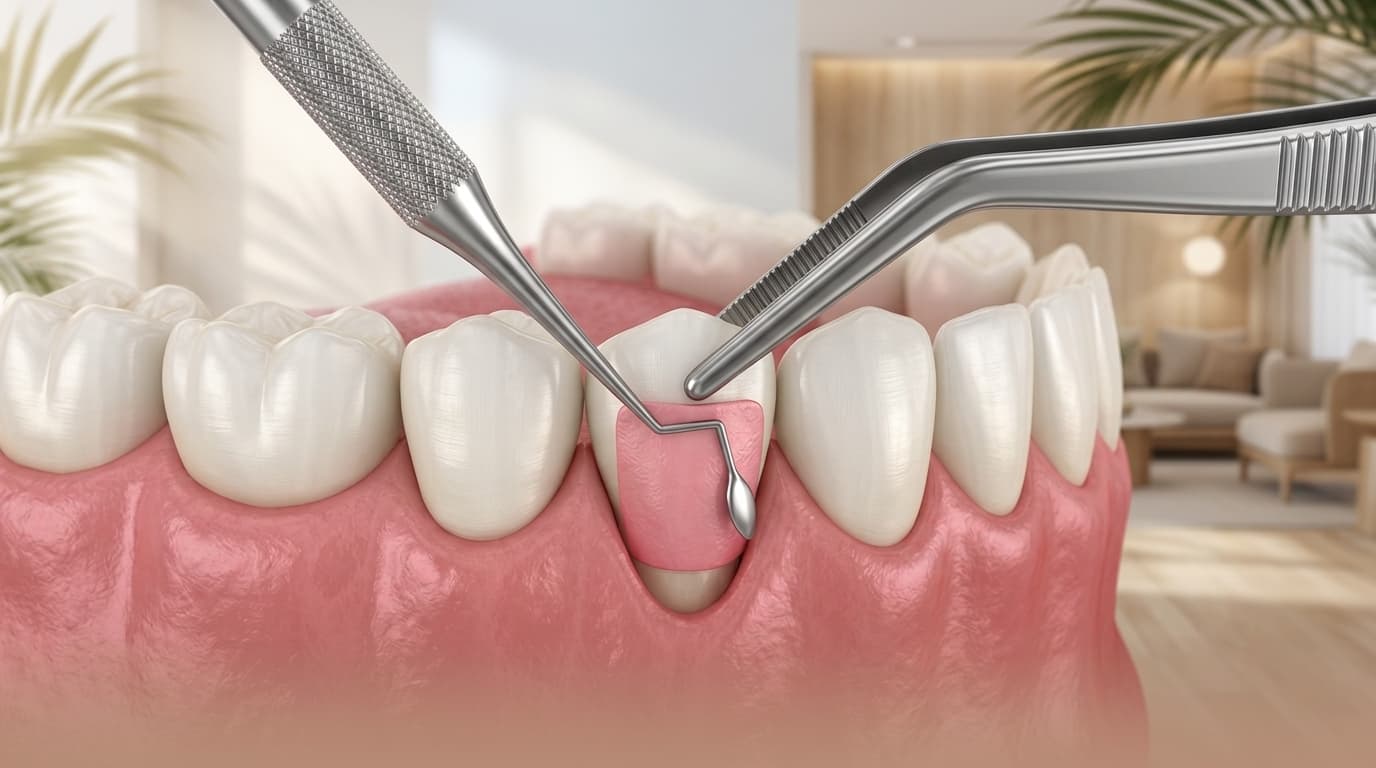
An implant itself is typically made from titanium or another biocompatible material — but the gum surrounding it is living tissue. The space between the implant and the gum, the underside of implant-supported bridges, and the gaps between neighbouring implants can all need extra attention during daily cleaning.
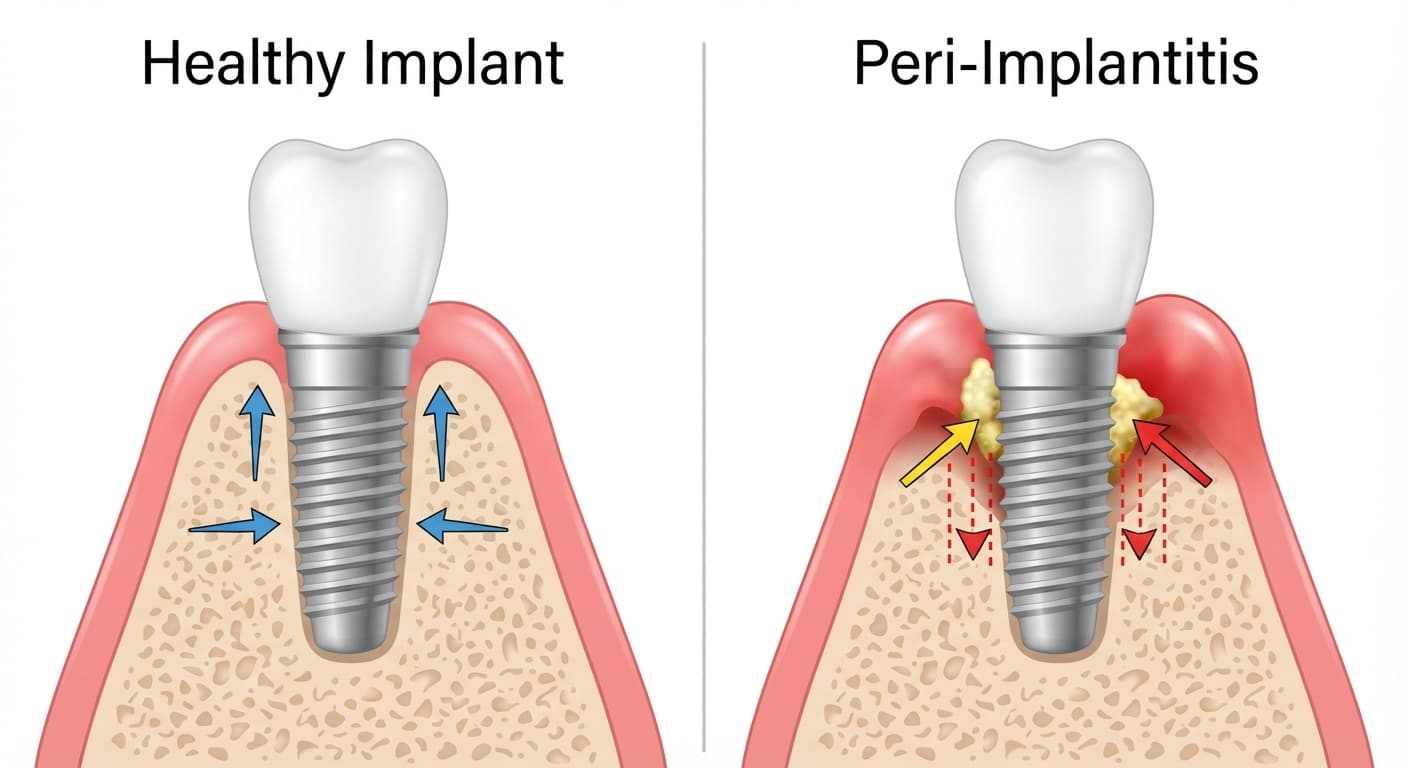
Neglecting oral care after implant treatment can allow plaque and bacteria to build up around the gum line. This can be associated with peri-implant mucositis, which may initially appear as redness, sensitivity or bleeding. If left untreated, some cases progress to affect the deeper tissue and supporting bone around the implant — a condition known as peri-implantitis.
Had Implant Treatment With Us?
Send us a photo of your implant site if you're ever unsure whether something looks normal — our team is happy to take a look.
2. How to Brush Your Dental Implants
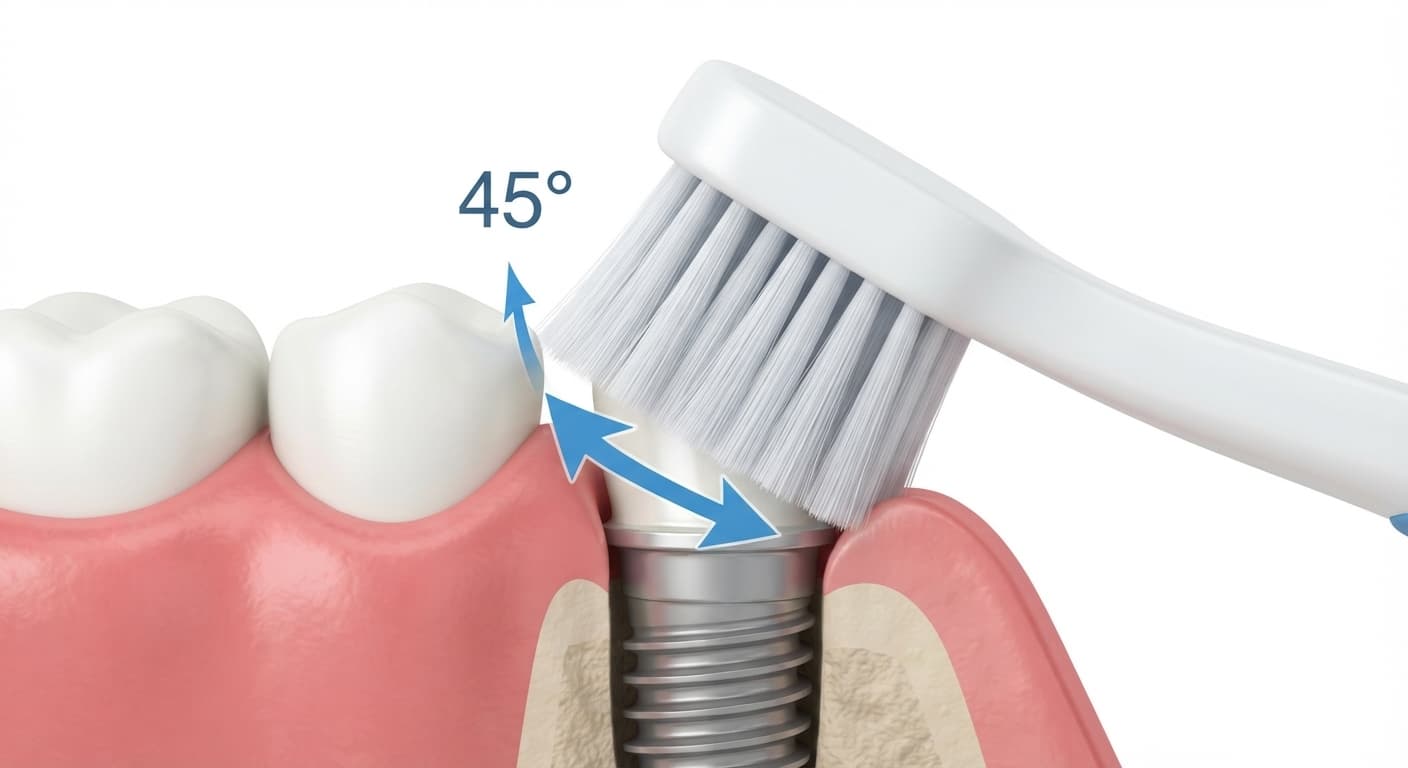
Having an implant doesn't mean you stop brushing — quite the opposite. Regular, correct brushing is one of the core pillars of implant aftercare. As with natural teeth, implant patients should generally brush at least twice a day for around two minutes. The exact technique can vary depending on the implant's position, the shape of the implant crown, whether a bridge or full-arch prosthesis is involved, and the patient's own gum anatomy.
Step 1 — Choose the right toothbrush
A soft or appropriately designed brush is generally suitable for cleaning around implants — manual or electric both work. What matters most isn't the brush itself but the technique: place it against the gum line with control and use small, gentle strokes rather than heavy pressure.
Step 2 — Don't skip the gum line
Avoiding the area around the implant for fear of "damaging" it is the wrong approach. The zone that needs the most attention is the transition between the implant crown and the gum. Angle the brush at roughly 45 degrees to the gum line and use gentle strokes — though the period immediately after implant surgery is different, and your surgeon's post-operative instructions always take priority over general brushing advice.
Step 3 — Clean every surface, not just the front
Brushing only the visible front of an implant crown isn't enough. Pay attention to the outer surface, the inner/tongue-side surface, the biting surface, the junction between crown and gum, the space between neighbouring implants, and the harder-to-reach areas under an implant-supported bridge or prosthesis. Implants further back in the mouth often need extra care simply because they're harder to see and reach.
Step 4 — Brush for around two minutes, systematically
Being systematic matters as much as timing. Try dividing your mouth into four zones — upper right, upper left, lower right, lower left — and cleaning each one in turn. This helps stop the same spot being skipped every time.
3. Cleaning Between Implants: Why Interdental Care Matters
Brushing alone usually isn't enough for thorough implant cleaning. Standard toothbrush bristles often can't reach the narrow spaces between teeth or implant-supported restorations. This is why interdental cleaning — cleaning the areas between teeth and implants — matters so much.
The American Dental Association (ADA) recommends cleaning between teeth with a suitable interdental product in addition to brushing. Which product is right for you depends on the width of the gap, the design of the implant-supported restoration, and your own oral anatomy.
4. Can You Floss Dental Implants?
Yes — floss can be used around some implant sites. But not every implant patient needs the same floss, or uses it the same way. Guiding standard floss into the right spot can be especially difficult around implant-supported bridges or full-arch implant prostheses.
For that reason, some patients are better suited to:
- Specialised implant floss
- Super-floss-style products with a stiffened end
- Interdental (proxy) brushes
- Water flossers (oral irrigators)
There is no single rule that "every implant patient must use the same product." Your dentist or periodontist can recommend the right method based on the design of your specific implant and prosthesis.
Explore Our Real Implant Cases
View All Cases →


5. How to Use an Interdental Brush, Step by Step
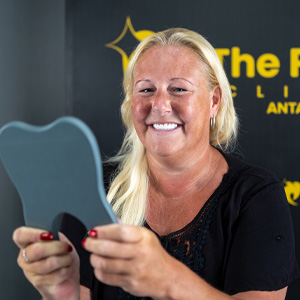
An interdental brush can be one of the most useful daily tools for cleaning around implants — but choosing the right size matters. A brush that's too small won't clean effectively; one that's too large, or forced into place, can traumatise the gum.
1. Choose the right size
The brush should pass through the gap with control, not resistance.
2. Position it between the implant and the neighbouring tooth or implant
Use a gentle motion rather than pushing it in by force.
3. Make a few controlled back-and-forth passes
The aim is to help dislodge plaque and trapped food particles from the area.
4. Repeat at each implant gap
Work through every space in the same controlled way.
5. Rinse the brush and replace it as recommended by the manufacturer
Worn bristles or a bent wire reduce how effectively the brush cleans.
Some interdental brushes designed for use around implants have a specially coated wire intended to avoid scratching the implant surface. It's worth asking your dentist which product they recommend for your specific case.
6. Should You Use a Water Flosser on Implants?
Water flossers use a stream of pressurised water to help clean hard-to-reach areas around teeth and gums. For patients with an implant-supported bridge or full-arch prosthesis, they can be useful for reaching underneath the restoration.
That said, a water flosser shouldn't be thought of as an automatic replacement for brushing or the interdental cleaning you actually need. Pressure settings matter too — in the period right after implant surgery, or when the gum is sensitive, follow your implant dentist's advice on when and at what setting to use the device.
7. Your Daily Implant Aftercare Routine
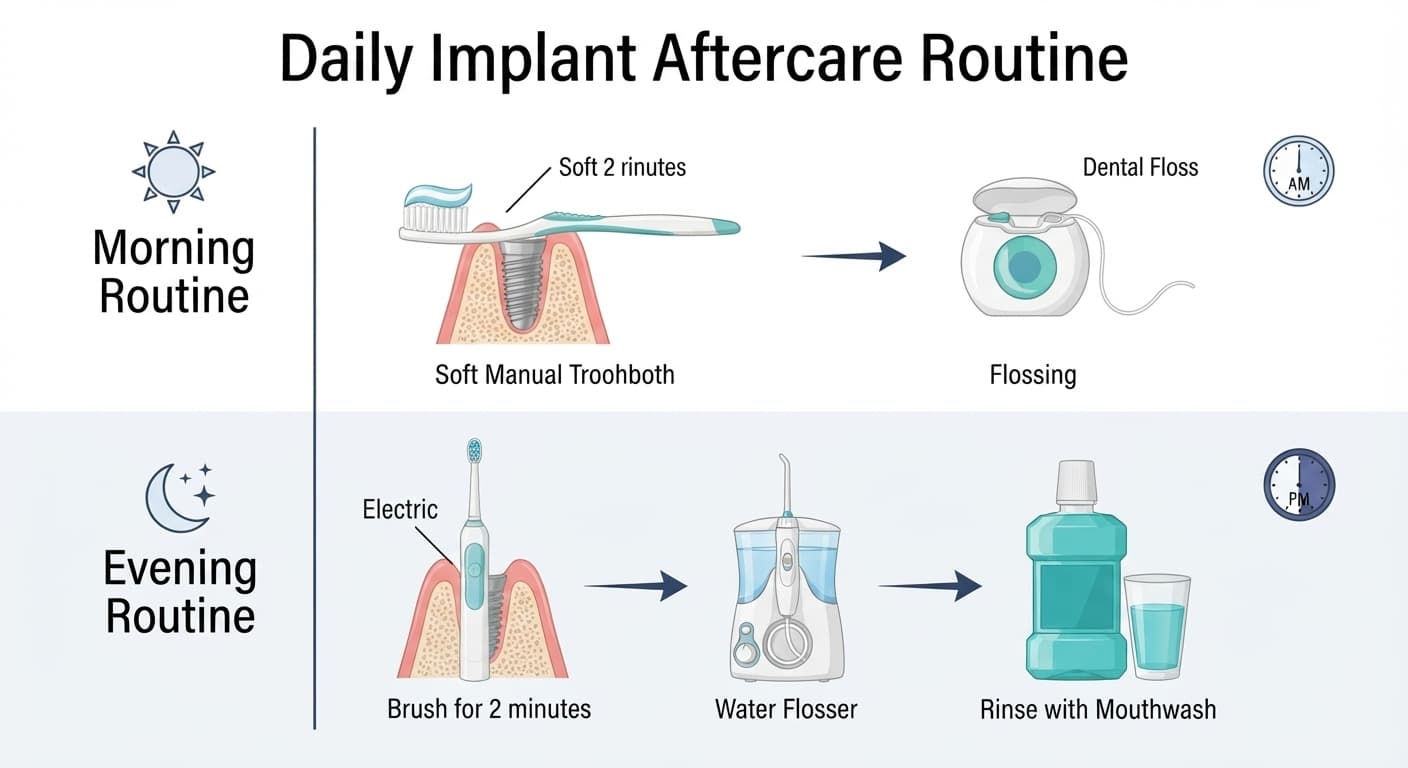
Once your implant treatment is complete, you can build a sustainable daily routine around it.
Morning
1. Brush your implants and natural teeth
Spend around two minutes cleaning all tooth surfaces and the area around each implant.
2. Check the area around the implant
Look out for excessive bleeding, swelling or unusual sensitivity.
Evening
1. Clean between teeth
Use the floss, interdental brush or other interdental cleaner recommended for you.
2. Clean around each implant
Make sure no food debris remains under a prosthesis or between implants.
3. Brush for around two minutes
Cover every surface, including the gum line around each implant.
4. Use any additional product your dentist has recommended
This might include a specific mouth rinse, gel or other aid.
EFP patient guidance lists brushing at least twice daily and cleaning between the teeth at least once a day among the core elements of implant aftercare.
Want to Discuss Your Aftercare in Person?
Meet our team face-to-face at a UK Dental Meet-Up event to go through your implant care routine and any questions before or after treatment.
Book Your UK Appointment8. Is Bleeding Around an Implant Normal?
Persistent or recurring bleeding around an implant shouldn't be ignored. If new bleeding appears around an implant during brushing or interdental cleaning — especially alongside redness, swelling, a bad taste or bad breath — it should be assessed by a dentist.
That said, bleeding on its own doesn't automatically mean "the implant has failed." The cause could be gum irritation, plaque build-up, or another issue around the implant. A clinical examination is the only reliable way to determine what's actually going on.
9. Swelling or Bad Odour Around an Implant
Swelling, a persistent bad smell, or a bad taste around an implant can have several different causes. A check-up is recommended if any of the following appear together:
- Redness around the implant
- Swollen gum tissue
- Bleeding during brushing or interdental cleaning
- Persistent bad breath
- A bad taste in the mouth
- Any looseness in the implant or the implant crown
- Increasing pain or sensitivity
- Discharge from around the implant
10. What Is Peri-Implantitis?
11. Do Dental Implants Get Cavities?
The implant itself doesn't decay the way a natural tooth does, because it isn't a natural tooth root and the restoration placed on top isn't made of natural enamel.
That doesn't mean nothing can go wrong around it, though. The gum and bone tissue surrounding an implant can still be damaged by bacterial plaque, and any remaining natural teeth in the mouth can still develop cavities as normal.
12. Toothpaste and Chlorhexidine: What to Use
Choosing a toothpaste
Toothpaste choice is generally based less on the implant itself and more on the patient's overall oral health, natural teeth and gum condition. Fluoride toothpaste is widely used in general oral care to help protect natural teeth from decay, but the products used in some implant care protocols can vary depending on the implant system, prosthesis type and gum condition. Rather than searching for a single "best implant toothpaste" online, it's more reliable to use the product and routine your own dentist recommends for your case.
Do you need chlorhexidine mouthwash after implants?
Chlorhexidine mouth rinses may be recommended by a dentist in certain clinical situations, but that doesn't mean everyone needs to use them long-term as part of a daily routine. EFP patient guidance notes that chlorhexidine products can be useful in some situations, but that long-term, uncontrolled use isn't advisable due to potential side effects such as tooth staining and taste changes. It's best not to use chlorhexidine or any other antiseptic rinse routinely — especially right after implant surgery — without your dentist's specific recommendation.
Not Sure Which Products Are Right for You?
Send us a message and our team can talk you through the toothpaste, floss or interdental brush suited to your specific implants.
13. How Often Should Implants Be Professionally Cleaned?
Daily home care matters enormously, but it doesn't fully replace professional check-ups. Your dentist or specialist can assess the tissue around the implant, check the condition of the implant restoration, and carry out professional mechanical plaque removal when needed.
The right interval isn't the same for everyone. A personal monitoring schedule can be built around factors such as the number of implants, any history of gum disease, oral hygiene habits, smoking, prosthesis design, and the current condition of the tissue around each implant. Patients with a previous history of peri-implant disease or periodontitis may need closer follow-up.
14. Common Implant-Cleaning Mistakes
1. Only brushing the implant crown itself
The gum line around the implant and the harder-to-reach areas also need cleaning.
2. Giving up on flossing or interdental cleaning entirely
Bristles can't reach every area — interdental cleaning suited to your case matters.
3. Brushing too hard
More pressure doesn't mean better cleaning — a gentle, controlled technique is what works.
4. Avoiding an area because it bleeds
If bleeding continues, the cause needs to be assessed rather than simply avoiding the area altogether.
5. Only seeing a dentist when there's already a problem
Regular check-ups as part of implant care help catch issues early.
6. Not cleaning underneath the prosthesis
Food debris and plaque can build up under implant-supported bridges and full-arch prostheses in particular.
15. Daily Implant Care Checklist
Use this short list to check your daily routine:
- Am I brushing my teeth at least twice a day?
- Am I cleaning around my implants gently and with control?
- Am I cleaning between my teeth every day with a suitable method?
- Am I cleaning the hard-to-reach areas of my implant-supported bridge or prosthesis?
- Am I checking for recurring bleeding or swelling in my gums?
- Am I attending the follow-up appointments my dentist recommends?
- If I smoke, am I getting support to help me quit?
- Am I contacting the clinic promptly if I notice looseness, pain or any unusual change around an implant?
16. Frequently Asked Questions (FAQ)
How do you clean a dental implant?
Implants should be brushed regularly like natural teeth, and the areas between implants cleaned with an interdental method suited to you. Depending on the design of the implant-supported restoration, floss, an interdental brush or a water flosser may be used.
How many times a day should implants be brushed?
In general, teeth should be brushed at least twice a day for around two minutes. Care around the implant should be part of this same routine.
Can you floss dental implants?
Yes, floss can be used around some implant sites. However, implant-supported bridges and full-arch prostheses may call for different interdental methods, and the right approach should be based on the design of your implant and prosthesis.
Can you use an interdental brush on implants?
Yes. An interdental brush of the correct size can help clean plaque and trapped food from between implants and implant-supported restorations.
What should I do if food keeps getting stuck under my implant?
If food debris keeps collecting under an implant-supported prosthesis, use the interdental brush, specialised floss or water flosser recommended for you rather than forcing the area clean. If the problem persists, it's worth having your dentist assess the prosthesis design and the tissue around the implant.
Is bleeding around an implant normal?
Recurring bleeding around an implant shouldn't be ignored. If it's accompanied by swelling, redness, bad odour or a bad taste, it should be assessed by a dentist.
Do dental implants get cavities?
The implant itself doesn't decay like a natural tooth. However, the gum and bone tissue around it can be affected by bacterial plaque, and any remaining natural teeth can still develop cavities.
Can I use ordinary toothpaste after getting an implant?
Toothpaste choice depends more on your natural teeth, gum condition and implant/prosthesis design than on the implant material itself. The most reliable approach is to follow the specific recommendation from the dentist who carried out your implant treatment.
Is an electric toothbrush suitable for implants?
Electric toothbrushes can be used with the right technique. What matters is avoiding excessive pressure and properly cleaning the gum line around the implant.
Is a water flosser necessary for implant cleaning?
A water flosser can help some implant patients clean hard-to-reach areas. However, it doesn't replace brushing or the interdental cleaning you still need to do.
How long does implant cleaning take each day?
The time needed for daily implant care can vary depending on the number of implants and the type of prosthesis used. What matters isn't speed but making sure every necessary area around each implant is cleaned regularly.
When can I start brushing after getting an implant?
Care immediately after surgery is different from long-term implant maintenance. In the first few days, exactly when and how to brush each area should follow the specific instructions from your implant surgeon.
What can I do to help my implants last as long as possible?
Good daily oral hygiene, regular professional check-ups, monitoring of the tissue around each implant, and avoiding smoking are all important factors in long-term implant care. How often you need follow-up can vary based on your personal risk factors.
Care Is Part of the Treatment
Implant treatment doesn't end when the restoration is fitted — long-term aftercare is an ongoing part of it. Get in touch and we'll talk you through a personalised care plan for your implants, natural teeth and gums.
Chat on WhatsAppThe Pearl Clinic Antalya — Dental Implants & Advanced Dentistry in Antalya, Türkiye
info@thepearlclinicantalya.com | Instagram | Facebook | TikTok
Results may vary from person to person with any surgical or interventional procedure. This content is for general informational purposes only and does not replace individual clinical assessment — a clinical examination is required to determine the most appropriate treatment and maintenance plan for each patient.